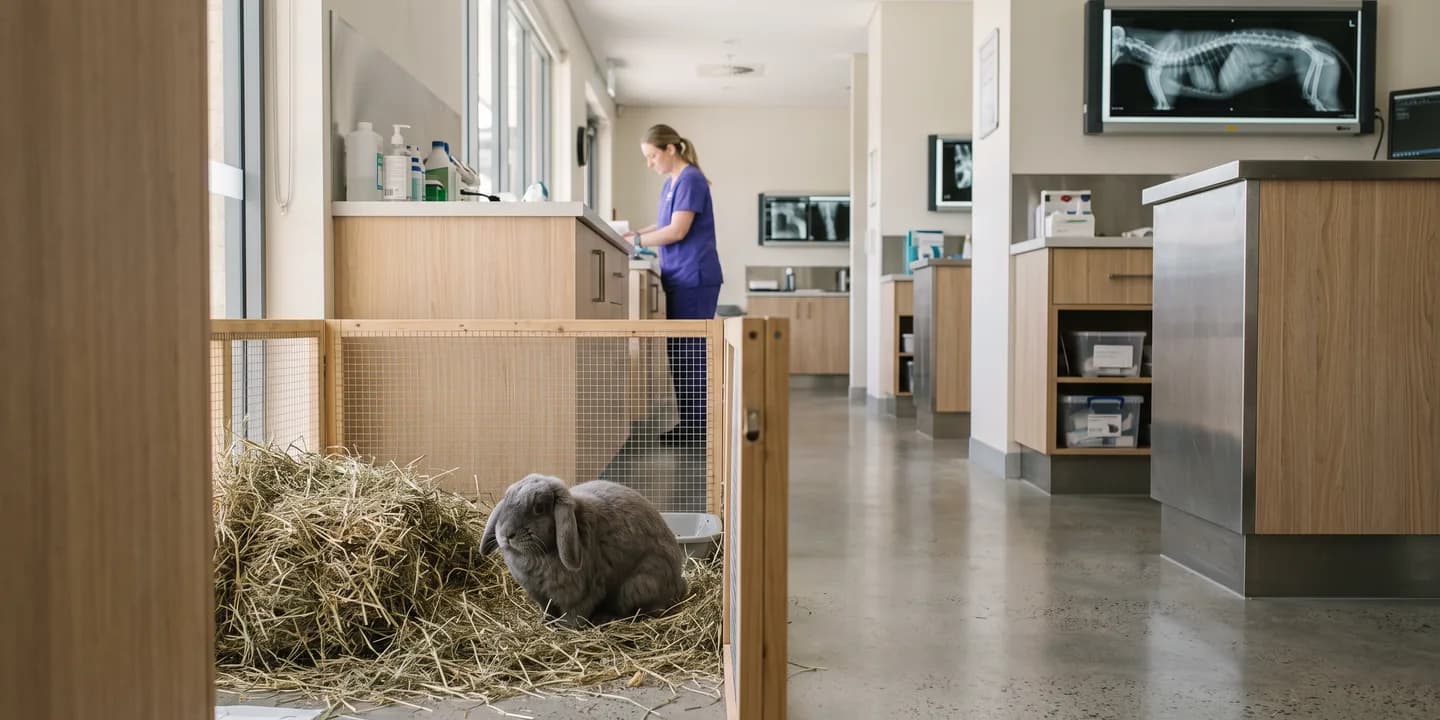
Most of the rabbit medicine we do at Joondalup and Midland traces back to how the rabbit was set up in its first fortnight. Get the diet, the housing and the vaccination right and a rabbit will often reach ten or twelve with very little from us.
Hay is eighty per cent of the diet
A rabbit needs a pile of grass hay roughly its own body size available at all times. Rabbit teeth grow throughout life and the sideways grinding of hay is what wears them evenly. A rabbit fed mainly on pellets grinds much less, grows sharp spurs on the molars, and eventually cuts its own tongue and cheek.
Pellets are a fifth of a cup a day for an average rabbit, and they are a supplement rather than a meal. Add a couple of handfuls of leafy greens. Muesli mixes with seeds and coloured pieces let a rabbit pick out the sugar and leave the fibre, and they are the diet we see the most dental disease behind.
Space, and the hutch problem
The traditional hutch is smaller than a rabbit needs by a wide margin. A rabbit should be able to take three consecutive hops and stand fully upright on its hind legs without touching the roof. In practice that is a pen rather than a cage, and rabbits do well living indoors with a litter tray, which most learn in a few days.
In a Perth summer an outdoor rabbit needs shade that lasts all afternoon and airflow. Rabbits cope with cold far better than with heat, and they show heat stress late.
The calicivirus vaccination
Calicivirus is present in Western Australia and it kills unvaccinated rabbits, including rabbits that never go outside, because the virus travels on insects, shoes and clothing. The vaccination is given from ten weeks and repeated every six to twelve months depending on the product. It is the single most important appointment a rabbit owner books.
Desexing
Female rabbits have a high rate of uterine cancer by four or five years old, so speying is a health decision rather than a behavioural one. Males are calmer and easier to house with a companion once desexed. Four to six months is the usual age for both.
The first appointment
Book a health check in the first fortnight. We weigh the rabbit, examine the teeth including the molars at the back, check the back end for soiling, look at the droppings you bring in, and go through the enclosure with you. It takes half an hour and it is the visit that prevents most of the others.
Two rabbits or one
Rabbits are social and most do better in a bonded pair. Both need to be desexed first, and bonding is a slow, supervised process rather than putting two rabbits in a pen together. Ask us before you start, because a failed introduction can injure both animals.